
What India has failed to acknowledge is that sub-conventional war is the name of the game and irregular forces have emerged with greater strategic value over conventional and even nuclear forces, and reliance purely on conventional force and diplomacy is grossly inadequate, says Lt Gen Prakash Katoch (retired).
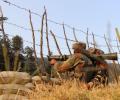
'India has to understand that the permanent state of war that exists between India and Pakistan has to be expected,,' says Colonel Anil A Athale (retd). 'The only way to ensure peace or absence of war is to maintain a militarily-dominant position over Pakistan.'
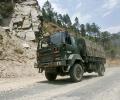
In 2005, the Border Road Organisation was asked to construct 73 roads in the strategically important regions along the Sino-India border but there has been huge delay in implementation of the project which has apparently left the army unhappy.

Tawang wears its history -- and also its present -- with ease. The flourishing town, with restaurants selling everything from noodles to dosas and locals returning home to new business prospects, shows little sign of the tension building up at the border about 40 km away to the north.
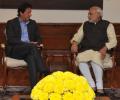
Pakistan's 'approach is one of getting even, an eye for an eye, or death by a thousand cuts.' 'The entire effort is to be the equal of India. Unfortunately, the reality is that this can never be the case.' 'India will always be the bigger, economically stronger, technologically more self-reliant country.' 'Therein, lies the dilemma Pakistan faces which leads it to perennial enmity with India,' notes Ambassador Gautam Bambawale in the Air Marshal Y V Malse Memorial Lecture 2019.
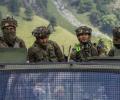
Today, the Ladakhis and Tibetans have been joined by the Sikhs, the Madrassis, the Garhwalis, the Rajputs, who are well trained psychologically and otherwise, to defend the nation, observes Claude Arpi.

With ambitious generals knowing that political patronage might be rewarded, a worrying era of politicisation of the military looms ahead, observes retired Colonel Ajai Shukla who has known Generals Rawat, Bakshi and Hariz for a long time.

Brigadier M P Bajwa (retd), commander of the troops that captured Tiger Hill, tells Rediff.com's Archana Masih how a band of young soldiers won the Kargil War's most famous battle with their blood and grit.
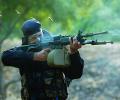
'The era of conventional wars is almost over in the Indian context.' 'In such a scenario, special forces could play a decisive strategic role in the spectrum of conflict.'

'Had they struck on the night of the 1st, there would have been hell to pay and had they been able to sneak further in, we would have had a greater problem,' says Lieutenant General H S Panag (retd), the former Northern Army Commander.

'100 Fayazs will bring a change in Kashmir, that's why they don't want a Fayaz.'

'You have been surrounded from all directions, if you want the safety of your troops and your personal safety, we will give you eight hours to make up your mind to surrender.'

'This is what we train for: That one chance to deliver a blow so lethal that the enemy will constantly think about it when planning any misadventure.'

'India was in no position to wage another war in 1965, having suffered a morale-shattering defeat in 1962. The three services were in the middle of a modernisation and expansion phase and therefore not fully trained or battle-ready.'
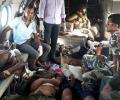
'The Naxalite strategy is to periodically attack police forces to provoke a reaction.' 'Once the security forces over-react and cause suffering to innocents by high-handed actions, the people will be alienated and support the revolution.' 'This appears to be the Naxalites' strategy and hence, their recent brutal killings of policemen,' says Colonel Anil A Athale (retd).

'It was almost as though there was widespread relief that the defence bureaucracy, and the minister, could find someone willing to shoulder the blame for everything that had gone wrong with the services under Antony's charge -- the poor preparedness of the forces, slow acquisitions caused by indecision, cancellation of contracts and whimsical blacklisting of defence contractors over the tiniest suspicion that they may have paid speed money or kickbacks.'
 © 2026 Rediff.com - Advertise with us - Disclaimer - Privacy Policy - Sitemap - Feedback - About us - Terms of use - Grievances